


Every purchase decision carries perceived risk — will this work, will I regret this, will I look foolish for choosing it? Brands that reduce this perceived risk win the sale. Trust doesn’t just influence whether someone buys once; it determines whether they come back, refer others, and forgive you when something goes wrong.
In a market saturated with choice, trust has become a bigger differentiator than price or even product quality. People don’t buy from the “best” option — they buy from the option that feels safest.
Human brains are pattern-recognition machines. When a brand looks, sounds, and behaves the same way across every touchpoint — website, social media, packaging, customer service — the brain files it as predictable, and predictable feels safe.
Inconsistency, on the other hand, triggers subconscious alarm bells. A polished website paired with a sloppy email signature, or a luxury positioning undercut by discount-bin pricing, creates cognitive dissonance that erodes trust before a single word is exchanged.
Application: Document your brand voice, visual identity, and messaging pillars in a single guide, and audit every customer touchpoint against it quarterly.
Psychologists have long observed that people develop a preference for things simply because they are familiar with them. This is called the mere-exposure effect, and it’s the reason repeated, consistent exposure to a brand — even without direct interaction — builds warmth toward it over time.
This is precisely why brand recall campaigns (retargeting, consistent content posting, sponsorships) work even when they don’t generate an immediate click. They’re not selling; they’re building familiarity, and familiarity is a trust shortcut.
Application: Prioritize consistent, frequent visibility (content, ads, email) over sporadic bursts of activity. Frequency compounds trust.
Humans are wired to look at others’ behavior to determine what’s safe or correct — a survival mechanism that translates directly into buying decisions. Reviews, testimonials, case studies, follower counts, and client logos all function as social proof, signaling “others have vetted this, so it’s safe for you too.”
Social proof is most powerful when it’s specific. A vague five-star rating is weaker than a testimonial that names a real result: “Increased our qualified leads by 40% in 90 days.”
Application: Feature specific, outcome-driven testimonials prominently on your website and proposals — not generic praise.
Decisions feel rational, but they are made emotionally and justified logically after the fact. This is a well-established finding in consumer psychology: the emotional brain decides first, and the analytical brain builds the justification.
Brands that only communicate features and specifications are speaking to the wrong part of the brain. Brands that evoke a feeling — security, ambition, belonging, relief — earn a place in memory that facts alone cannot reach.
Application: Lead your messaging with the emotional outcome (what the customer will feel), then support it with rational proof points (data, process, credentials).
Counterintuitively, brands that admit limitations are often trusted more than brands that claim perfection. This is sometimes called the “pratfall effect” — a credible source that shows a small flaw is perceived as more honest, and therefore more trustworthy, than one that presents itself as flawless.
Overselling triggers skepticism. Modern consumers, especially those raised on social media, have finely tuned skepticism toward polished perfection and gravitate toward brands that communicate with transparency.
Application: Be upfront about what your product or service isn’t for. Publish honest case studies that include challenges, not just wins.
Research on first impressions suggests people form a judgment about a website or brand within a fraction of a second, largely based on visual design. Color psychology, typography, and layout aren’t decoration — they’re the first trust signal a prospect receives, often before they’ve read a single word.
A dated, cluttered, or inconsistent visual identity communicates neglect, and neglect reads as unreliability. A clean, intentional design communicates competence, even before your copy makes its case.
Application: Treat your website and visual identity as a trust asset, not just an aesthetic one — invest accordingly.
The principle of reciprocity is one of the most well-documented drivers of influence: when someone receives something of value, they feel a natural pull to return the favor. Brands that lead with free value — educational content, tools, honest advice — build goodwill that lowers resistance when they eventually make an offer.
This is why content marketing outperforms cold, feature-first selling in the long run. It builds the trust account before it makes a withdrawal.
Application: Give away your best insights freely. It builds authority and reciprocity simultaneously.
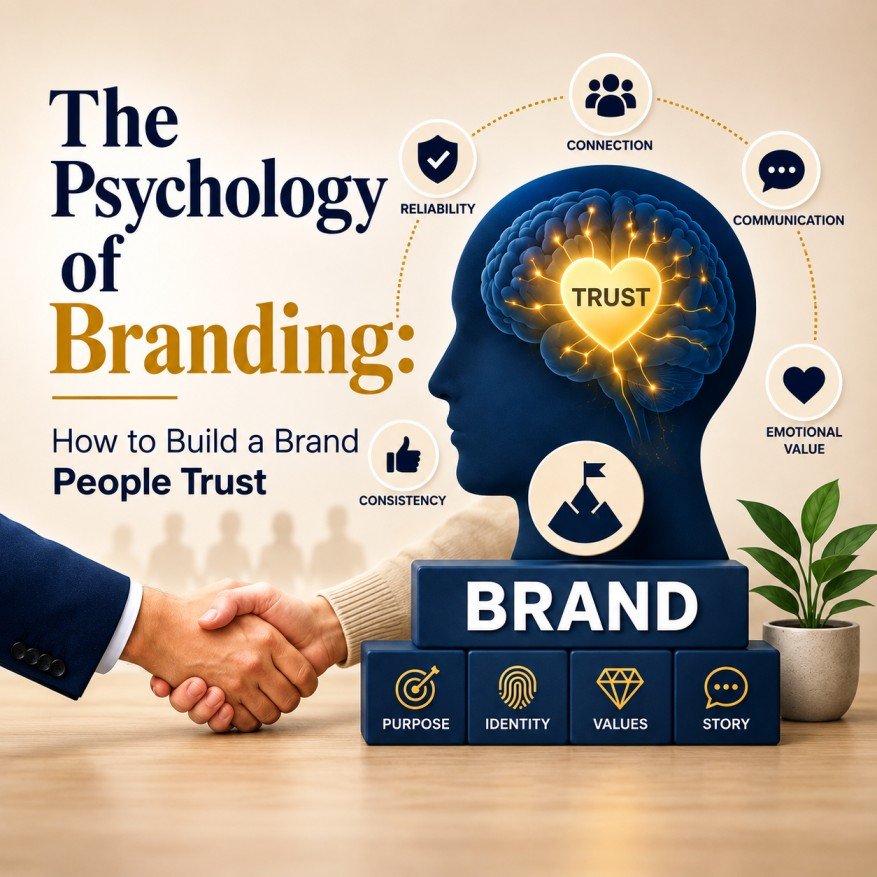
Brands that score well across all four pillars don’t just get chosen once — they get chosen repeatedly, and recommended without being asked.
Building a brand people trust isn’t about clever slogans or a bigger marketing budget — it’s about understanding how the human brain evaluates safety, familiarity, and credibility, and designing every brand touchpoint around those principles. Trust, once built, becomes the most durable competitive advantage a business can own — one that’s far harder for competitors to copy than a price point or a feature list.
Brand trust compounds over time through consistent exposure and proof, typically taking months of steady, aligned activity rather than a single campaign.
Yes — arguably more, since smaller brands lack the built-in credibility of scale and must earn trust deliberately through consistency and proof.
Specific, outcome-based social proof (testimonials, case studies) paired with a consistent, professional visual identity delivers the fastest initial trust signal.



Empowering your business with strategic insights, innovative solutions, & expert guidance for sustainable growth and success.
© Copyright 2026 UpliftDigital – All Rights Reserved.